



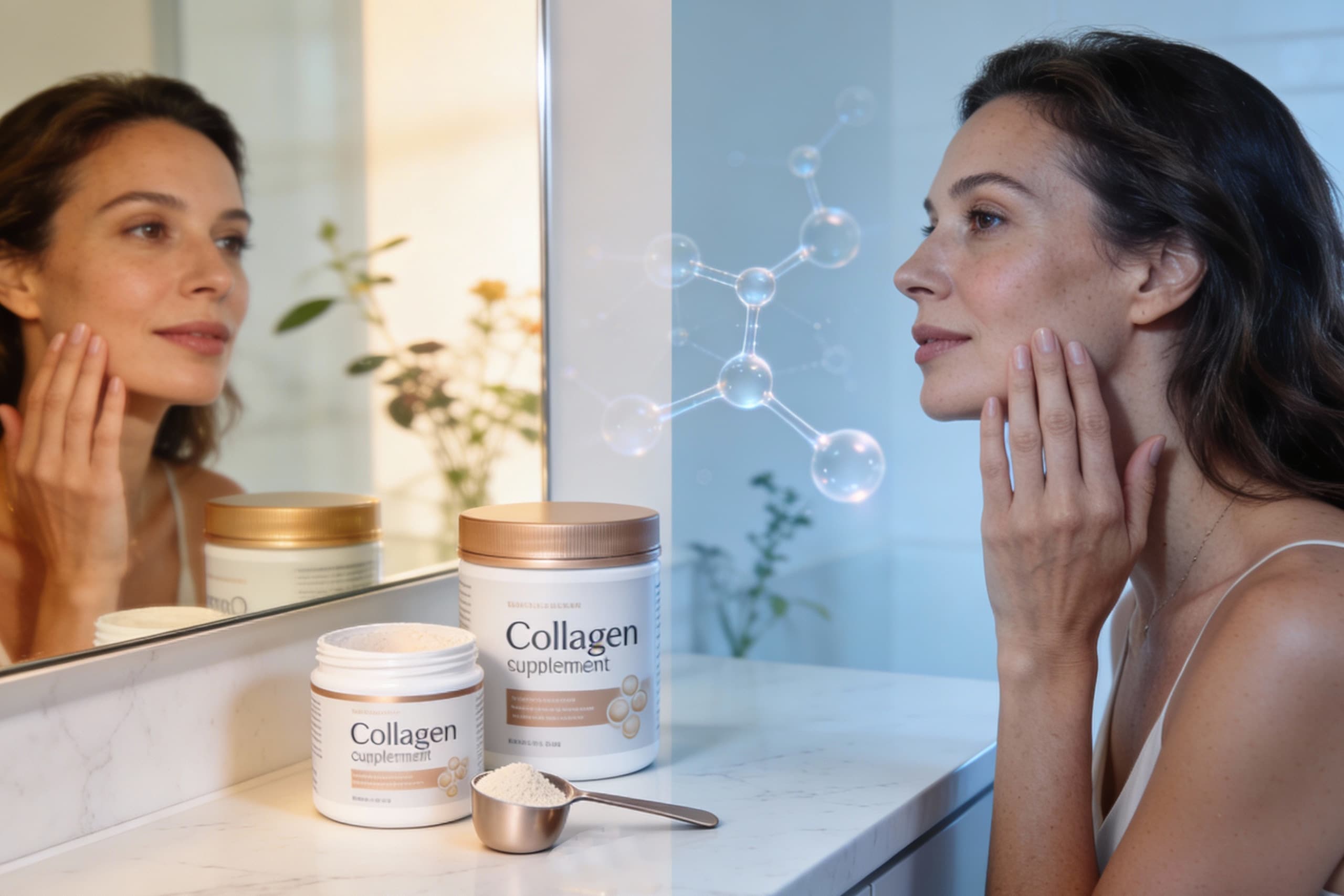
The Collagen Craze: Science vs. Fiction
Walk into any pharmacy or scroll Instagram and you will see collagen everywhere: powders, gummies, coffee creamers, even “collagen water.” The promise is big: glowing skin, thicker hair, stronger nails, pain-free joints.
If you are skeptical, you should be. For years, critics argued that eating collagen is pointless because digestion breaks it down like any other protein. The update is this: your gut does break it down, but research shows some collagen-specific small peptides (especially hydroxyproline-containing di- and tripeptides) can appear in the blood after ingestion, which supports the “it might do something” side of the argument.
Here is the evidence-based guide to what collagen can (and cannot) do, and how to use it realistically.
1) What Is Collagen, and Why Do We Lose It?
Collagen is the most abundant protein in the body. It provides structure for skin, cartilage, tendons, ligaments, and bone. Collagen production declines with age. One commonly cited estimate is about a 1% decline per year starting in early adulthood, and in menopause the drop can be much faster (about 30% in the first five years).
Lifestyle accelerators include UV exposure, smoking, and high-sugar diets (glycation and oxidative stress both work against collagen).
2) The “Stomach Acid” Myth: What Bioavailability Actually Means
Yes, collagen is digested. The point is not that collagen “survives” digestion intact, but that after hydrolyzed collagen (collagen peptides) is consumed, measurable amounts of collagen-related metabolites and small peptides show up in circulation, including hydroxyproline-containing di- and tripeptides.
Why hydrolyzed collagen matters: it is pre-broken into smaller peptides so your body can absorb it more efficiently than native collagen. These peptides may act as signals that support connective-tissue remodeling, but the exact “how much and in whom” is still being researched.
3) Benefit #1: Skin Hydration and Elasticity (What the Best Evidence Supports)
The strongest human evidence for collagen supplements is in modest improvements in skin hydration and elasticity over time (usually 8 to 12 weeks). Meta-analyses of randomized trials have found statistically significant improvements in hydration and elasticity compared with placebo.
Reality check: this is not a facelift. Expect “slightly plumper, better hydration, softer fine lines,” not dramatic structural reversal. Also, many trials are small and some have potential bias, so keep expectations grounded.
Topical collagen note: collagen in creams can help surface hydration, but it is generally too large to reach the dermis where collagen-making cells live. Treat collagen creams as moisturizers, not rebuilders.
4) Benefit #2: Joint Pain and Mobility (Where It Can Help, and Where It Won’t)
For joints, the evidence is more mixed, but there is support for pain reduction in knee osteoarthritis in pooled analyses of randomized trials, with an important caveat: the included trials can be small and at risk of bias.
Translation: collagen may be a useful add-on for some people with joint discomfort, but it is not a replacement for weight management, strength training, physical therapy, or medical treatment when needed.
5) Which Type Do You Need?
Most “collagen peptides” products are hydrolyzed collagen, usually rich in Type I and Type III (commonly marketed for skin, hair, nails). Type II is more cartilage-focused, and you will see it in two very different formats:
- Hydrolyzed collagen peptides (grams): often used in studies for skin and joint comfort.
- Undenatured Type II (milligrams): a different ingredient with a different mechanism and very different dosing (often around tens of mg, not grams).
If a label says “Type II,” check whether it is undenatured Type II or just a source claim. The dosing will tell you which one it is.
6) The Vitamin C Connection (Important, but People Overstate It)
Vitamin C is required for collagen biosynthesis. Without adequate vitamin C, collagen formation and connective-tissue integrity suffer. You do not necessarily need a collagen product that contains vitamin C, but you do need enough vitamin C in your diet overall.
Practical move: take collagen with a meal that includes vitamin C (citrus, berries, peppers) if your diet is inconsistent.
7) Dosage: How Much Is Enough?
Dosing depends on the goal and the collagen form:
- Skin: Many trials use a few grams daily, and effects are typically seen after 8 to 12 weeks.
- Joints (collagen peptides): studies and reviews often use higher gram-range doses; benefits are generally gradual.
- Joints (undenatured Type II): dosing is usually in milligrams, not grams (read labels carefully).
Consistency matters more than timing hacks. If you take it “sometimes,” expect “sometimes” results.
8) Safety and Shopping Rules
- Side effects: usually mild GI upset (bloating, fullness), especially at higher doses.
- Allergies: marine collagen is a problem if you have fish allergies.
- Quality: choose reputable brands and look for third-party testing when possible.
Summary: Is It Worth It?
Collagen supplements can be worth it if you want modest, measurable support for skin hydration and elasticity, and possibly joint comfort over time. They are not magic, and they do not cancel out sun exposure, smoking, poor sleep, or low protein intake. Sunscreen and overall nutrition protect the collagen you already have; supplementation is an optional add-on.
Need Help Choosing?
If you are deciding between bovine vs. marine, peptides vs. Type II, or you want a realistic dose for your goal, ask a pharmacist to match the product type to your target and your allergy or diet constraints.